Lots
of boats come to Oriental, some tie up at the Town Dock for
a night or two, others drop anchor in the harbor for a while.
If you've spent any time on the water you know that every boat
has a story. The Shipping News on TownDock.net brings you the
stories of the boats that have visited recently.
Monday, July 14, 2003
GAVIA IMMER -- An Uncommon Common Loon
Boat names get our attention. Not all of them, mind you. We have a pretty good sense of what "Dawn Treader" means and won't have further questions, but if your boat has an uncommon name, like "Molly Bloom" or "Fred" or "Alonzo's Sea", you've made us curious. We'll likely to want to ask you about it.
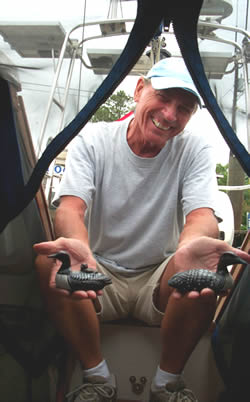
John and two of his carved loons |
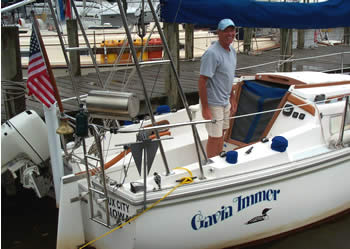
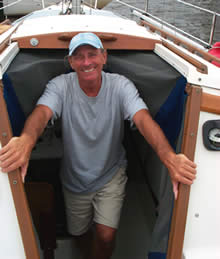
In June, a Catalina 25 named "Gavia Immer" from Sioux City, Iowa tied up at the Town Dock. The name intrigued us.
Gavia Immer Gavia Immer, we kept repeating. It sounded so uncommon, so mystical. Gah VEE ah, Im MARE. We imagined that's how it would be pronounced. And when we said it that way, it conjured up images of some Indian Ocean god of the wind or waves.
Turns out the name was far more common than we could have imagined.
John Funke, who has been living on"Gavia Immer" since 1997 says the name means "Common Loon" -- 'gavia' being the genus, and 'immer' the species. (One hint might have been the loon silhouette painted just below the name.)
"It's my favorite bird." John says, of the bird that swims great lengths underwater. It dives in, he says, "without a splash. It's beautiful."
Down below on "Gavia Immer" John has several carved loons, loon prints and other representations of the bird he so loves. He confides that "Gavia Immer" was not his only choice for a boat name. He had toyed with naming the Catalina 25 after the family name for the loon, Gaviidae. But then he learned that a mall in Minneapolis was already calling itself that and he didn't really want people to think he'd named the boat for a shopping mall.
The boat lists "Sioux City, Iowa" as its port of call, not a common sight in Oriental. It's there on the transom of "Gavia Immer" because Iowa is where John grew up. He's not lived there in decades --- "I couldn't do the winters anymore," he says --- but now that he's living on the boat, Iowa has again become his legal residence because as he puts it with a laugh, "You have to be from somewhere."
Iowa is actually more than a legal residence. It is where John first learned to sail fifty years ago. It happened indirectly, through his father.
"My father was a fisherman," John says. But fishing with his father was "not a lot of fun," he adds. "Typically I had to row the boat. And rowing was hard for a kid, because his boat was heavy."
In those few years after the Second World War, outboard motors were not as widespread as they are now. For a 12-year old who didn't like rowing, there remained only one other option.
"I discovered sail boats," John says. "Being able to go across water without oars or a motor... that was a discovery." When he says this, fifty years later, John is inside a coffee shop looking across the rainy street at the Oriental Town Dock and the boat he lives on. He smiles a lot and laughs as he talks about his early awe at this idea of sailing. "It was remarkable.. almost spiritual. It was amazing to be able to do that with the elements."
He learned to sail Sunfish-type boats, and spent hours on the lakes of Iowa -- Storm Lake, Spirit Lake, Okoboji Lake. He recalls working hard at learning to sail... and at keeping his peanut butter and jelly sandwiches dry. "I would hang them from the boom," he says. "It was the only dry place on the boat."
Though he moved away from Iowa to go to college -- "I went to school in San Antonio, Texas and discovered the rest of the world wasn't frozen" -- the attraction to boats stayed with him. He eventually moved to Palm Springs, California (another non-frozen place) and worked for decades as navigator on large ships that assisted oil companies in scouting underwater oil sites. The work took him to the seas off of the East, West and Gulf Coasts and to Africa. Summers he would spend sailing on the Great Lakes, around the loons that inspired this boat's name.
When he retired 6 years ago he had "Gavia Immer" trucked to San Diego, then spent years outfitting her before cruising off the Pacific Coast of the US and Mexico. John's been working his way up from Florida since 2001.
He says he had planned to do more sailing in Mexico and the Pacific, but that changed after 9/11. He is now "doing stuff locally, on the US coastline." John and Gavia Immer were headed toward the Chesapeake when they stopped in Oriental in May.
He happened upon Oriental after hearing about it over the radio.
John is a ham radio operator (K0GPN) and notes that there are a lot of amateur radio operators in the Oriental area. (He's learned that "they meet once a month for luncheon at Ms Sils'") With so many radio operators based around here, he says, "Oriental is talked about a lot."
If not for hearing that chatter over the air, John may not have come to Oriental. "It's a well-kept secret," he says, and points out that the town is "off the ICW enough so that you have to make an exit" from the waterway to come here.
By all appearances, even on a rainy Saturday afternoon, John appeared happy he'd made the effort. "You don't realize the magnetism," he says, "until you get here."
So, how much longer will he live on Gavia Immer? "Who knows?" John talks about not making plans, but says he figures he has "five more years of sailing." Or perhaps a combination of sailing and some time on land. "I'm thinking of going to work, " John says. "I'm kinda bored with retirement. I miss the social part of work."
He laughs at how this may not jive with the name he has given his boat. "It's ironic that the loon is an isolationist type bird." Solitude, John says, is "nice but I like to turn it on and off. A quiet anchorage is good, but there's nothing wrong with four or five cruising boats in it."
posted 7/14/2003 02:12:00 PM
Thursday, July 03, 2003
GOLDEN BREEZE -- Another Atlantic Crossing
Marcel Waltzer sailed across the Atlantic last year on “Golden Breeze”, a 37-foot Motiva. His wife and two young children joined him in the Caribbean, and togehter they planned to travel up the ICW from Florida to New York.
But they took longer than they thought they would on the ICW because “it was so beautiful everywhere.” By August “Golden Breeze” had gotten only as far as Oriental and by then it was time to fly home to Switzerland where Marcel works as an architect. The family left the Danish-made steel pilothouse cutter in Oriental.
Marcel came back to Oriental in May, and spent some time preparing the boat for the return trip across the Atlantic. A friend arrived in late May and they took off toward Bermuda in early June. We caught up with Marcel a few day before that, at the docks alongside SailCraft Service yard.
Crossing the Atlantic is not anything new to Marcel. He figures he’s gone across that ocean 6 or 7 times in the past 25 years.
Half a dozen transatlantic crossings seemed a lot for someone from a land-locked country. But as Marcel puts it, “the Swiss are always looking to the sea.” That’s one reason, he says, that the Alinghi syndicate that recently won the America’s Cup “became very popular,” back home.
As for Marcel, he has sometimes crossed the Atlantic with other crew and sometimes gone all by himself.
He made his first crossing in the late 1970’s. In the 1980’s one of his Atlantic crossings took him to Brazil where he spent three months in the Amazon.
From that trip he recalls one anchorage, far up the Amazon. It was a remote place, where few of the indigenous people even spoke Portuguese. One day, he says, three elderly men paddled up to his boat in a wooden canoe. “They knocked on the boat, and then scratched it a bit,” Marcel says. Then he says, they backed away and spoke among themselves before they paddled up again and scratched the fiberglass hull some more. Finally, he says, one of the men spoke out, in Portuguese, and said he wanted to ask a question.
“’Where do trees grow to build a boat like this?”
Marcel says it was difficult to explain fiberglass.
More recently, Marcel has been meeting the inhabitants of Oriental, which he calls one of the most beautiful places, "because of the people. I’ve felt welcome.”
And he remarks that from his vantage point near Whittaker Creek, he’s noticed that people seem to use their sailboats a lot. (It was a heartening observation for those of us who don't feel like we get out on the water enough.)
Here, Marcel says, “I’ve felt it may be that a lot of people are real sailors.” He pauses, saying he’s not trying to criticize France. (He keeps his boat in a Mediterranean port in the south of France.) But he notes that “it’s completely changed in the last 20 years there” and that many boat owners don’t seem to venture out of the harbors.
Wall of Toast
On the other hand, he does have a qualm with one aspect of American life, a subject he broaches carefully, diplomatically even.
“One of the most important things," he says, "is the French bread'. The crunchy, crusty baguette is something he hasn't been able to find in US grocery stores along the ICW. Rather, Marcel notes, he goes to the bread aisles and is faced with what he describes as “a wall of toast.”
(We did direct him to the new bakery in town next to the Post Office).
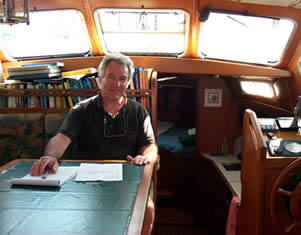
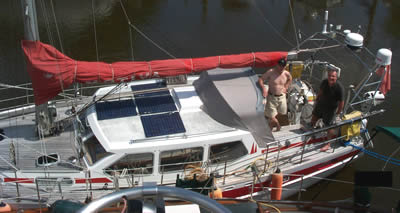
Marcel’s Motiva 37 was built in Denmark for sailing in the North Sea. In those waters, the pilothouse is a refuge from the wet and cold. For most of the time Marcel has owned the boat it has been in lower -- and warmer -- latitudes such as the Med -- and more recently, Oriental. In those places, the light and airy space of the pilothouse serves another purpose; Marcel says that one reason he bought it 7 years ago was that “I don’t like to sit in the cellar of a normal sailboat.”
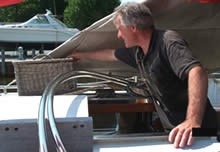
The Motiva has clean lines, to which Marcel has added a wicker basket. He says that he puts it on deck during his ocean passages, and that he's kept vegetables in it for weeks at a time. Inside the basket he says, vegetables remain dry and cooled by the air that passes through.
As for wind blowing by the boat, Marcel says he’s been sailing for 30 years and has seen “every kind of weather.”
But he adds that the strongest winds are not necessarily the worst. “A 6-7 force wind blowing you away from your target is worse than a 9-10,” blowing you toward it.
Last year, NYC had been his target. It wasn’t wind on the nose that kept him from reaching it, but rather he and his family taking their time through the southern part of the ICW. NYC by boat may have to wait for another day. After this crossing, Marcel doesn’t have any more transatlantic plans in the works.
He expects that traversing the ocean will take a month of outright sailing -- between NC-Bermuda-Azores-Gibraltar -- before reaching his homeport in the South of France.
And then he’s looking to venture out of the harbor there and cruise in the Eastern part of the Mediterranean and visit old (really old) towns and churches.
posted 7/03/2003 08:03:00 AM
|
If
you have news of a boat -- sail boat, trawler, kayak, anything that
floats -- that's come to Oriental, drop us a line here at news@towndock.net
|
|