
It's Thursday June 11, 2026

December 2002
Down this Christmas because your stock portfolio is down? Get a life. And don’t tell any Polish jokes in my presence if you don’t want me to bust you in the chops. You’ll soon learn why.Oriental is blessed with having two Charlie Garrett’s. One is a chief, one is a captain.
Most people know the chief. He drives a big red pickem-up leading bigger red trucks with flashing red lights to protect our homes and businesses from fire.
The captain drives a bus, more specifically, a Boeing 737 bus for American Airlines, the airline that hasn’t declared bankruptcy. When the captain is not driving the bus, he and his lovely wife, Charlotte, spend every waking moment in Oriental.
They have managed to create leave time from flying the bus so that this year they can spend the entire holiday season here in Paradise. They are sharing this good fortune with Charlotte’s mother, Anna.
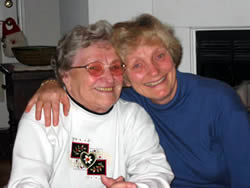
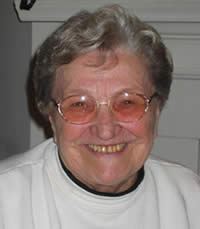
Seen at The Bean in the early morning hours, Anna might be mistaken to be Charlotte’s sister. She has become a hit with Pamlico County people who love good people – that’s because Anna is herself good people … very, very good people.Mother & Daughter – Anna & CharlotteAnna Sosnowski was born in 1925 in a small Polish farming community. Her father’s occupation was what we would call Game Warden. Her mother worked their small number of acres from sun-up to sun-down to help feed the family of six. Anna says, “We were not rich, we were not hungry. When I reached seven years of age, I was old enough to keep watch over our seven cattle.”
Ominous signs of change came just days before Anna turned 14. Germany invaded Poland on September 1, 1939. Anna recalls, “Lots of houses were burned. For fun, the Germans shelled cabbage fields. We stayed in our house but others scattered into the forest and into corn fields trying to hide.”
According to Anna, the Germans were relentless in the bombing for the first three days. Later the Russians advanced from the East and Poland was divided between those two armies along the Buk River. Anna’s village was east of the river in the part of Poland controlled by the Russians.
“We hid our cattle and other food but the Russians found them and took them. They were poor and even took clothes from us for their army and their people back home. Because we were afraid, we gave them food when the soldiers came begging. Mama would give them something to eat and then close the door,” Anna remembers.Anna SosnowskiChristmas in 1939 was quiet. Anna’s family had enough to eat and they were even able to go to church. They were not really afraid of the Russians drastically changing their lives at that point.
But shortly after the Christmas of 1939, on February 10, the village dogs were joined in a barking tirade by frantic sounds from just about every other creature in the vicinity.
Anna’s father investigated. He returned to their home and told his family that the Russians were taking everyone away. “Mama said, ‘Not us. We have done nothing wrong.’ Father said, ‘They are taking everybody,’ “ Anna tells in what is beginning to be a voice interrupted by the need to use a tissue for her eyes.
Four soldiers entered their humble home. Anna throws her arms in the air as she tells how they made everybody put their hands up as they confiscated her father’s gun he used as the local game warden. Anna’s mother cried. A Ukranian whispered instructions quickly into the ear of her father. "Take all the food and clothing you can. They are shipping you out of the country," Anna said.
I sat in a straight back chair in Charlie and Charlotte’s living room, watching the story of horror unfold from Anna’s lips as she sat on one end of a sofa, often gesturing with her hands to illustrate the severity of their plight.
The Russians took them by cattle train to Siberia, a trip that lasted three months. Once her mother fainted. Those nearby squeezed their fingers through the wire fence caging of the cattle car to grab snow to melt so they could revive her mother by offering her water.
Sixty people stuffed in one cattle car had to fight off hunger and a plague of lice. "When we crossed the Polish border into Russia, everybody cried. We had one bucket of soup for all sixty of us. The soup was made from beet leaves, pickled cucumber and so little barley you count the individual grains.
When we were taken off the train, we had to walk for two days through the snow to get to the prison camp," Anna continued.
Upon arrival there, her mother and younger brother were placed in a hospital with typhoid. Anna was put to work harvesting pine resin or cutting wood, depending upon the season. The work week was Monday through Saturday, 12 hours each day. The rations were a piece of bread, but only if the workers met production quotas arbitrarily established by their captors. Anna says, "It amounted to about 80 grams of bread for one whole day. We would take dry bread and soak it in water to make it expand so it would be more filling for us."
And Christmas … "We worked. We had one day each week, Sunday. If Christmas came on a Tuesday or a Wednesday, we worked."
Anna’s family had no Christmas celebration, no feast with all the trimmings — for three long, grueling years. Relief began to take shape in late December of 1942 when a Polish general struck a deal with Stalin. All the Polish men would become soldiers fighting with the Russians if the women and children would be freed from the slave labor camps.
Anna, her mother and her siblings were freed and made their way south to Uzbekistan. Sadly, the freedom did not come soon enough for her mother. She died shortly after arriving in Uzbekistan.
Her father was later mortally wounded in combat. The remnants of the family made it to Iran where the British government took a caretaker’s role for the Polish refugees.
Let’s recount this story. A woman celebrating the Spirit of Christmas this weekend in Oriental spent three of her teenage years in a slave labor camp in Siberia subsisting on bread and water and occasional small distributions of various grains.
I sat in the Garrett living room – dazed. How could I really comprehend what had just been told to me? Would I ever be able to do justice in telling this remarkable story about this remarkable woman to others?
I lost all sense of journalistic sense.
Charlie saved the moment for me. He turned to his 77 year old mother-in-law and said, “Mama what would you want to say to others who celebrate Christmas now?”
“Thank you God. We together. We have food. We have presents under the tree. But most important, we free. We can talk what we want. God Bless America.”
Postscript: Anna Sosnowski passed away peacefully in her sleep March 15, 2010. Anna was 84. This column first ran in December 2002.

| As well as directing PR for Pamlico Community College, Ben Casey is a photographer and photo essayist. You can learn more about Ben and his books at www.bencaseyphotos.com. |

