
It's Wednesday June 10, 2026
June 30, 2010
The free rides on the Minnesott-Cherry Branch ferry are getting a closer look, setting up the possibility that Neuse River passengers may someday pay for the trips.Over the next half year, North Carolina’s Ferry Division will be looking at whether to charge a fee on the four ferry routes that are currently free. Those are: Minnesott-Cherry Branch, Aurora-Bayview, Currituck-Knot’s Island and Hatteras-Ocracoke. Also to be considered, whether to raise the fees already charged on three other routes.
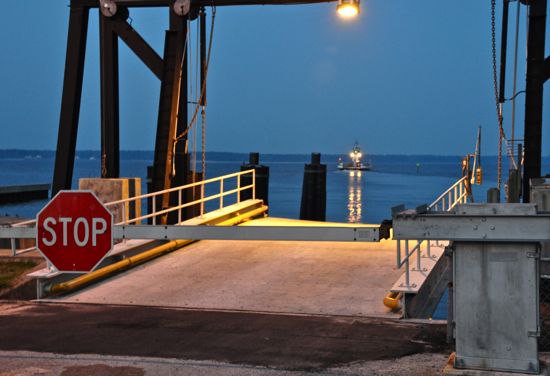 Tantalizingly close. The ferry leaves Minnesott’s shores for Cherry Branch.
Lucy Wallace, a spokeswoman for the Ferry Division, says that at the North Carolina General Assembly this spring, the House Transportation Appropriations Subcommittee asked that the Department of Transportation’s ferry service “look into becoming more self-sufficient.” Wallace says the subcommittee wanted “a fee schedule for ferry routes that would cover operating costs.”
That may be much easier said than done.
At the moment, the NC Ferry Division takes in about 2 million dollars a year from the three paying routes — Ocracoke-Cedar Island, Ocracoke-Swan Quarter and the Southport ferries.
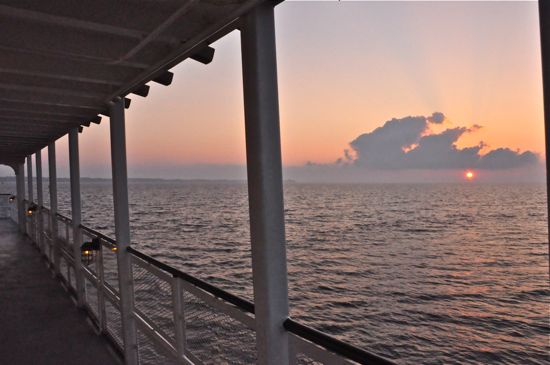 A sunrise on the three-mile long Minnesott-Cherry Branch ferry route.
It cost $32 million to run those three routes – and the four no-pay ferries – last year. The House Transportation Appropriations subcommittee this spring voted to grant an $11 million increase to pay for meeting Coast Guard staffing standards and inspections. That would bring the Ferry System’s operating budget to $43.5 million next year. At that rate, expenses would overshadow income more than 20 times over.
To raise more funds, the Ferry Division could charge more for the long trips to Ocracoke, where $15 now buys a 2-1/2 hour ride for a vehicle less than 20 feet long. Money might also be raised by charging a fee on the now-free ferries. However, a study done at North Carolina State University suggests that such hikes would not come close to covering expenses.
Last year, NCSU’s Institute of Transportation Research and Education compiled data on the ferry runs and offered projections of how much money might feasibly be raised. It took in to account that there would be a monthly pass arrangement available for commuters, and with that would come a reduced per-trip rate.
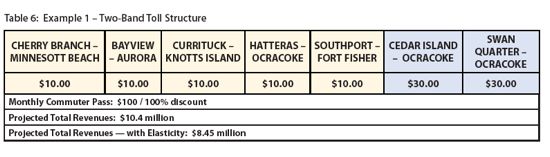 In this table, trips across the Neuse could cost $10 and regular commuters could purchase monthly passes that would significant reduce their cost-per-trip. (Table from NCSU’s Institute of Transportation Research and Education.)
One scenario called for increasing the Ocracoke ferries fee to $30 a trip while charging $10 a trip on the shorter ferry runs — the four that are currently free and the Southport ferry. In the end, that could raise 10.4 million. But the study also warned of a potential drop off in passengers who wouldn’t want to pay. Figuring in that “elasticity,” the study projected that the revenues would be $8.45 million.
The NCSU study also considered charging $12 a trip on the shorter routes and $50 on the Ocracoke runs. It projected that as much as $13.8 million might be raised, but since such higher fees might even more greatly depress ridership, it was possible revenues could be even less than the other scenario.
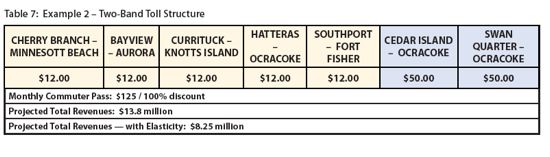 Finding the right price will take some work. Charging $12 for a ferry ride rather than $10 could bring fewer passengers, which would mean less revenue. (Table from NCSU’s Institute of Transportation Research and Education.)
These projected revenues fall far short of covering the Ferry System’s operating budget and other factors may make it difficult to have income match outlay.
Lucy Wallace says that the legislative request to making the ferry system more self-sufficient stipulated that students and teachers who used the ferry to get to school should still ride for free. Another consideration: what additional labor costs there would be in selling and collecting tickets on each run.
“You would really have to charge a whole lot to make it 100 percent self reliant,” says Wallace.
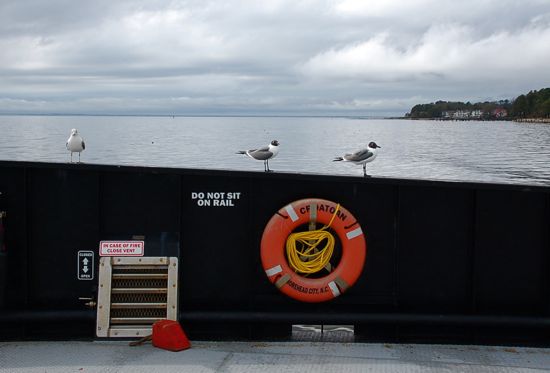 At the moment, the ferry across the Neuse is free.
The two most used ferry routes in North Carolina are currently free. The Hatteras-Ocracoke run carries almost a million people a year, while the second busiest ferry is the Minnesott-Cherry Branch run which in 2009 carried 260,000 vehicles and 453,000 passengers. (Those numbers were slightly down from the year before due to a cutback in the number of trips, most of which have since been restored.) On average, there are 23 vehicles per trip across the Neuse. Unlike the Hatteras ferry which caters mainly to tourists, the Minnesott Ferry has a large number of commuters who would otherwise have a very long drive.
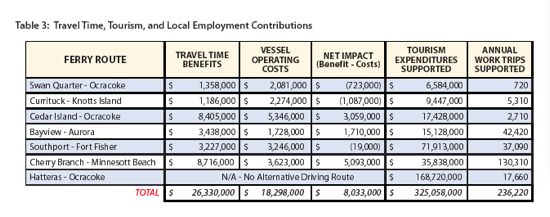
Of all the ferry runs, the Minnesott-Cherry Branch route had the most work-related trips and also provided the greatest benefit in terms of road miles and time that were saved. (Table from NCSU’s Institute of Transportation Research and Education.)As reported here last year when the ferry schedule was cut back, some Minnesott-Cherry Branch commuters say they wouldn’t mind paying something if it meant the difference between having a ferry and not having one. But in the passenger survey conducted as part of the NCSU study, only 45% of the Minnesott ferry riders embraced the idea of paying, the lowest level of support of all the ferry routes.
The Department of Transportation has a February 2011 deadline to submit its report on a fee schedule.
Posted Wednesday June 30, 2010 by Melinda Penkava

 • May 2026 - The Pig Celebrates 10 Years • May 2026 - NOAA's Prediction: A Below Average Hurricane Season • April 2026 - Cycle NC 2026 • April 2026 - April Town Board Meeting 2026 • April 2026 - Zac Schnell, AI and Community Engagement • April 2026 - The 2026 Oriental In-Water Boat Show • April 2026 - Eston “Sherrill” Styron, 1942 - 2026 • April 2026 - Capsizing on the Creeks: SailPack 2026 • April 2026 - 2026 PAWS Pet Parade • March 2026 - The Dragon Burn That Didn't • March 2026 - James "Jimmy" Edward Ragan, III, 1941 - 2026 • March 2026 - March Town Board Meeting 2026 • March 2026 - Loblolly Pines & Pollen • March 2026 - Russell "Russ" Bryan Stevenson, 1932 - 2026 • March 2026 - Town Board Acts Fast in Fight for Funds