
It's Monday June 15, 2026

Lots of boats come to Oriental, some tie up at the Town Dock for a night or two, others drop anchor in the harbor for a while. If you've spent any time on the water you know that every boat has a story. The Shipping News on TownDock.net brings you the stories of the boats that have visited recently.
June 14, 2010
Aboat from the NOAA National Marine Fisheries program in Beaufort will soon be plying the waters of the Gulf of Mexico counting dolphins in the wake of BP’s oil disaster. That dolphin head count will later help NOAA track the effect that the oil gushing from the BP well is having on the mammals in the Gulf and its estuaries.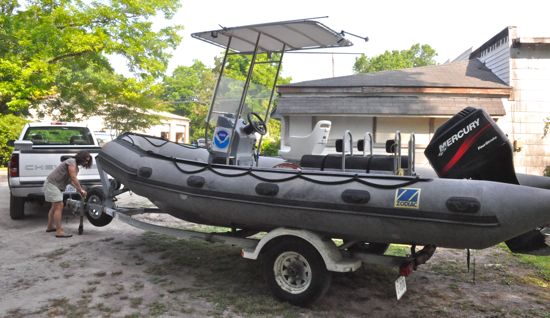 Annie Gorgone delivering NOAA’s boat to Will Flannery’s for repairs on Friday. This NOAA boat is a RHIB — a rigid hulled inflatable boat — and once repaired will be sent to the Gulf of Mexico as part of a dolphin-counting effort.
Before the 21-foot boat could head out though, it needed some repairs. Which is why on Friday morning, NOAA marine biologist Annie Gorgone trailered the RHIB — or rigid hulled inflatable boat — from Beaufort to Oriental and Will Flannery’s repair shop.
There were leaks on the port side of the boat, Will said. It was the kind of thing that would require frequent re-pumpings if it weren’t fixed.
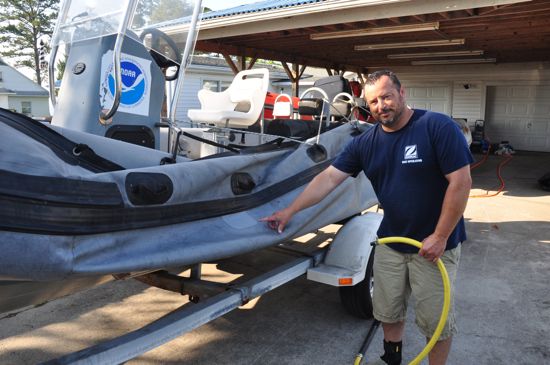 Will Flannery showing one of the several patches he had to put on the inflatable.
Will made the repairs to the dolphin-counting boat over the weekend. The job hit close to home and ties in to Will’s other sideline, Offshore Rafting, in which he takes folks out on the Pamlico Sound and beyond for dolphin watching tours.
The NOAA boat had been sidelined for several years in Beaufort. Aleta Hohn, director of the NOAA National Marine Fisheries program, says that cutbacks in recent years meant that the boat and biologists weren’t going out to count dolphin in NC waters.
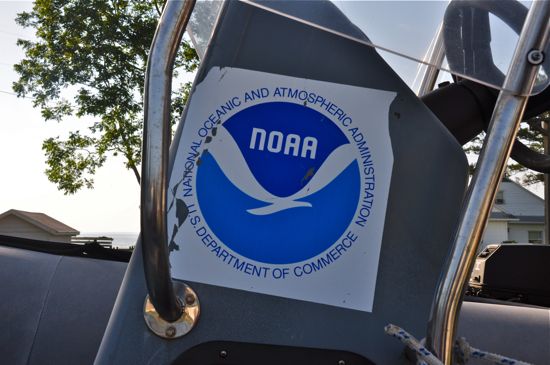
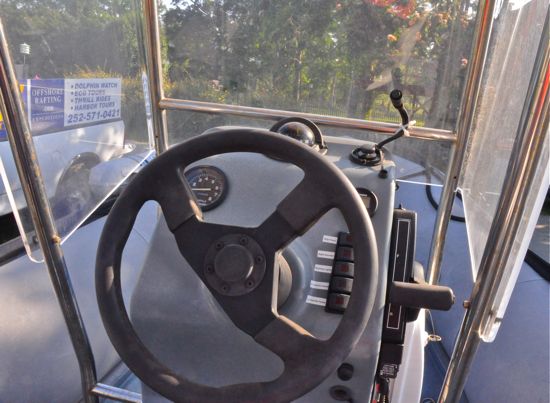 Through the windshield of the NOAA boat.
The emergency in the Gulf reordered some priorities which is why the biologists will be busy once again doing “abundance” studies. To do that work, they needed a boat that could handle rough waters — whether out in the deep or in the shallow areas where they’d follow the dolphin.
The NOAA boat that was repaired in Oriental is one of two that will be working on the count. The two vessels will work two separate areas at a time, a method that aims to take in to account dolphins who might swim from one spot to another.)
Annie Gorgone says that another biologist will count the dolphins for the first two weeks, and then she will do a two-week stint. It’s expected that the NOAA teams could be out for more than 10 hours a day.
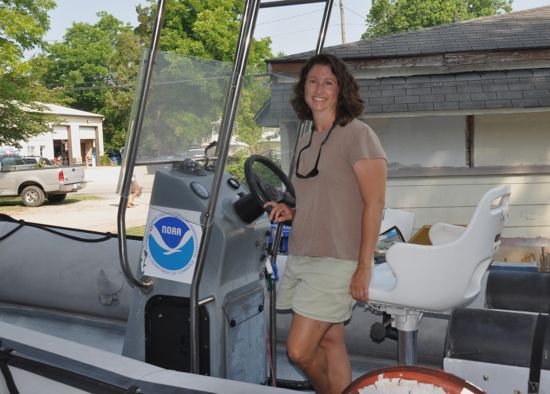 Biologist Annie Gorgone on the NOAA inflatable she brought to Oriental for repairs on Friday. After the fix, the boat will be headed to the Gulf of Mexico as part of a dolphin-counting study.
A camera is an important tool for the job. In particular says Gorgone, they are taking photos of the dorsal fins of the dolphin. Akin to a human fingerprint, the dorsal fin is such an individualized feature, it can be used to tell dolphins apart.
Over time, that dorsal fin data can be referred to if dolphins move far away or are found ailing in the water. Or even more tragically, if they turn up dead. What the biologists would want to know is how the dolphin were affected by inhaling or otherwise ingesting the BP oil that’s now polluting the Gulf.
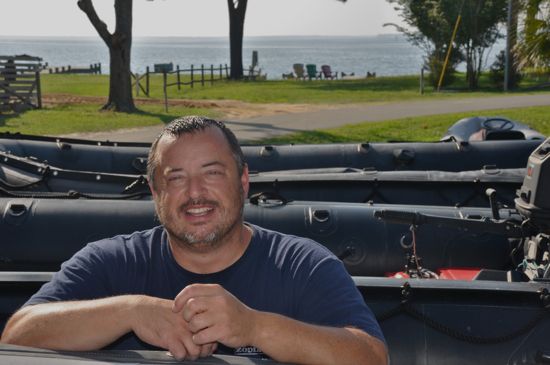 Will Flannery, who repaired the boat that NOAA will use in the Gulf.
Aleta Hohn says that some aerial surveys have already shown dolphin swimming through the oily parts of the Gulf. Much has been said about the intelligence of dolphin, but Hohn says that they wouldn’t necessarily know to swim away from oil. For one, they don’t have a sense of smell. Even if they did, Hohn says, they might not instinctively know that oily waters could pose a risk.
As for how marine life in the waters of NC might be affected by the oil from the Gulf, Hohn says that NOAA will be on standby and watching for that. For the summer though, the boat that used to ply NC waters, will be off the coasts of Louisiana and Mississippi. “We’re just happy,” she says, “to be helping in the Gulf.”
Posted Monday June 14, 2010 by Melinda Penkava


 • May 2026 - From Argentina to Whortonsville • February 2026 - Mads and SV Spiffy • July 2025 - John and the Birds • July 2025 - Capt. Carl Cannon Jr. & Pirate Ship “Adventure” • June 2025 - SV Mysto • March 2025 - 1926 Motor Yacht Mariner III • January 2025 - SV Skookum Takes On The World • November 2024 - SV Naia • March 2024 - Wes Barbour and SV Summer Wind • December 2023 - Pauline and SV Elektra • October 2023 - The Coati & The Mermaid • June 2023 - SV White Seal • April 2023 - SV Sarah G • March 2023 - SV Pepita • February 2023 - S/V Surprise • January 2023 - SV Thunderstriker • December 2022 - S/V Capitaine Bontems • November 2022 - Schooner Huron Jewel • July 2022 - Ashley, Apache, and SV Friends • February 2022 - Sam Rouse and SV Nortena • December 2021 - Coastal Conversations • February 2021 - Brother Sister Dory Story • December 2020 - Alan, David Bowie, and Blue 9 • November 2020 - Waiting for the Right Time • September 2020 - Camping in the Creeks • August 2020 - Solo Cruiser Emily Greenberg • June 2020 - SV Mudfog Cove Returns • March 2020 - SV Beyond • February 2020 - Shahid & SV Safina • January 2020 - Electric Vessel with Historic Roots • May 2019 - SV Misto Circumnavigates • April 2019 - MV Sea Glass • March 2019 - Steve Chard: Kayaking the Great Loop